
Proteinmaxxing is having a moment, and for good reason. Research published in the Philosophical Transactions of the Royal Society shows that when dietary protein is diluted by fats and carbohydrates, the body responds by needing more food overall, a phenomenon called protein leverage [1]. In short: if your protein-to-calorie ratio is off, you eat more to chase what your body actually needs.
That's exactly why the math on a protein shake matters more than the marketing.

The Ratio Most Shakes Don't Want You to Notice
Walk down any supplement aisle and you'll find shakes delivering 10–20 grams of protein for 300+ calories per serving. That's not proteinmaxxing, that's caloriemaxxing in disguise. Once you factor in added sugars, oils, and filler carbs, the protein you're actually getting per calorie is significantly less than the label implies.
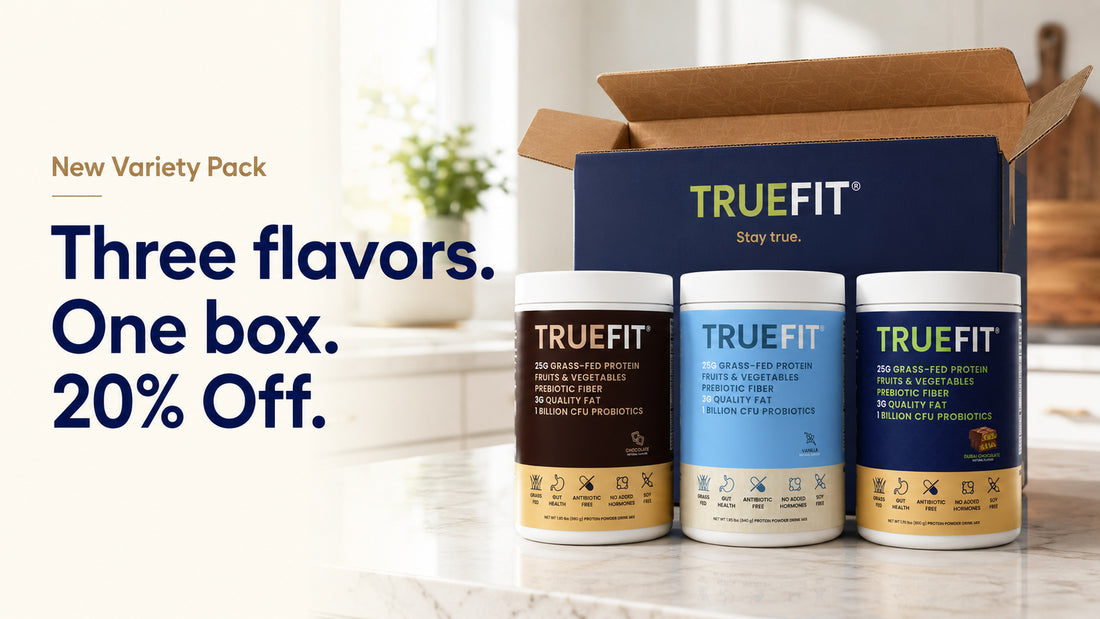
TrueFit was built around a different equation: 25 grams of grass-fed protein for just 150 calories. Scoop for scoop, that ratio outperforms most of the category. For anyone tracking macros, building lean mass, or staying in a deficit while still hitting protein targets, the math compounds fast. Three servings a day = 75g of protein for 450 calories, versus 30–60g for nearly twice the calories from a legacy shake.

The Part Nobody Mentions: Fiber
Here's where TrueFit pulls even further ahead, and it has nothing to do with marketing copy.
The average American consumes only about 14 grams of fiber per day, roughly half of what's recommended [2]. The American Heart Association and Academy of Nutrition and Dietetics recommend 25–38 grams daily, depending on age and sex [3]. That gap matters for more than digestion. Dietary fiber influences nutrient absorption through fermentation, bulking, viscosity, gel formation, and water-holding capacity and prebiotic fiber supports gut microbes that regulate how the body processes what you eat [4].
In other words: protein doesn't just need to be consumed. It needs to be absorbed. And absorption is a function of gut health.
That's why TrueFit includes 5g of prebiotic fiber and 1 billion CFU probiotics in every scoop. Fermentable fibers are broken down by gut microbiota to produce short-chain fatty acids, which support intestinal barrier function and microbial balance [5], the conditions that make protein worth taking in the first place. The fiber feeds the microbes. The probiotics reinforce the population. Together, they create the gut environment where 25g of protein actually does the work of 25g of protein.
The Bottom Line
Proteinmaxxing without absorption is just expensive guesswork. A higher protein-to-calorie ratio means you hit your targets without overshooting. A built-in fiber and probiotic system means your body can actually use what you put in it.
That's not a marketing claim. That's how digestion works.

Featured Products
-
 Bestseller
TrueFit Protein Powder - Vanilla
Regular price $59.99Regular priceUnit price per$54.99Sale price $59.99Bestseller -
 Top Reviewed
TrueFit Protein Powder - Chocolate
Regular price $59.99Regular priceUnit price per$54.99Sale price $59.99Top Reviewed


Sources
[1] Raubenheimer, D. & Simpson, S.J. (2023). "Protein appetite as an integrator in the obesity system: the protein leverage hypothesis." Philosophical Transactions of the Royal Society B, 378(1888).
[2] American Heart Association News. "Sound the fiber alarm! Most of us need more of it in our diet." (January 2022).
[3] American Heart Association. "Fiber, Lipids, and Coronary Heart Disease." Circulation, 95(12).
[4] Harvard Health Publishing. "Should I be eating more fiber?" (February 2019).
[5] Animals (MDPI). "Effects of Dietary Fiber Fermentation and Protein Digestion Properties on Growth Performance and Microbial Metabolites." (June 2025).